

Dumaguete Video Tour: Manjuyod Sandbar, Apo Island and Evenings
A researched Dumaguete video tour guide: the Manjuyod Sandbar, Apo Island, evenings in town, and how to say hello in Bisaya.

Video credit: this Dumaguete video tour, “Hmm.. Why do AMERICANS LOVE Dumaguete, Philippines,” was filmed and published by RayKayTV, a YouTube channel with travel videos from the Philippines. If you enjoy it, please visit the channel and subscribe to support their work. The video was uploaded on August 15, 2025, so prices and venues may have changed since.
Researched guide: built from video tours and travel sources, linked at the end. Prices and schedules change with the season and the dates of your trip, so treat any cost here as a rough range and confirm locally before you book.
What the video shows
RayKayTV’s video is titled as a question: why do Americans love Dumaguete? It ends with a short, tasteful tour of two nightclubs, with people simply enjoying the evening. Here are the moments worth watching for.
- 5:36 Paula picks out a new perfume in the mall
- 8:00 A tour of The Henry Resort in Dumaguete
- 11:35 Impressed with the Boulevard Boardwalk
- 23:00 Nightclub nightlife examples, including a short tour of two nightclubs
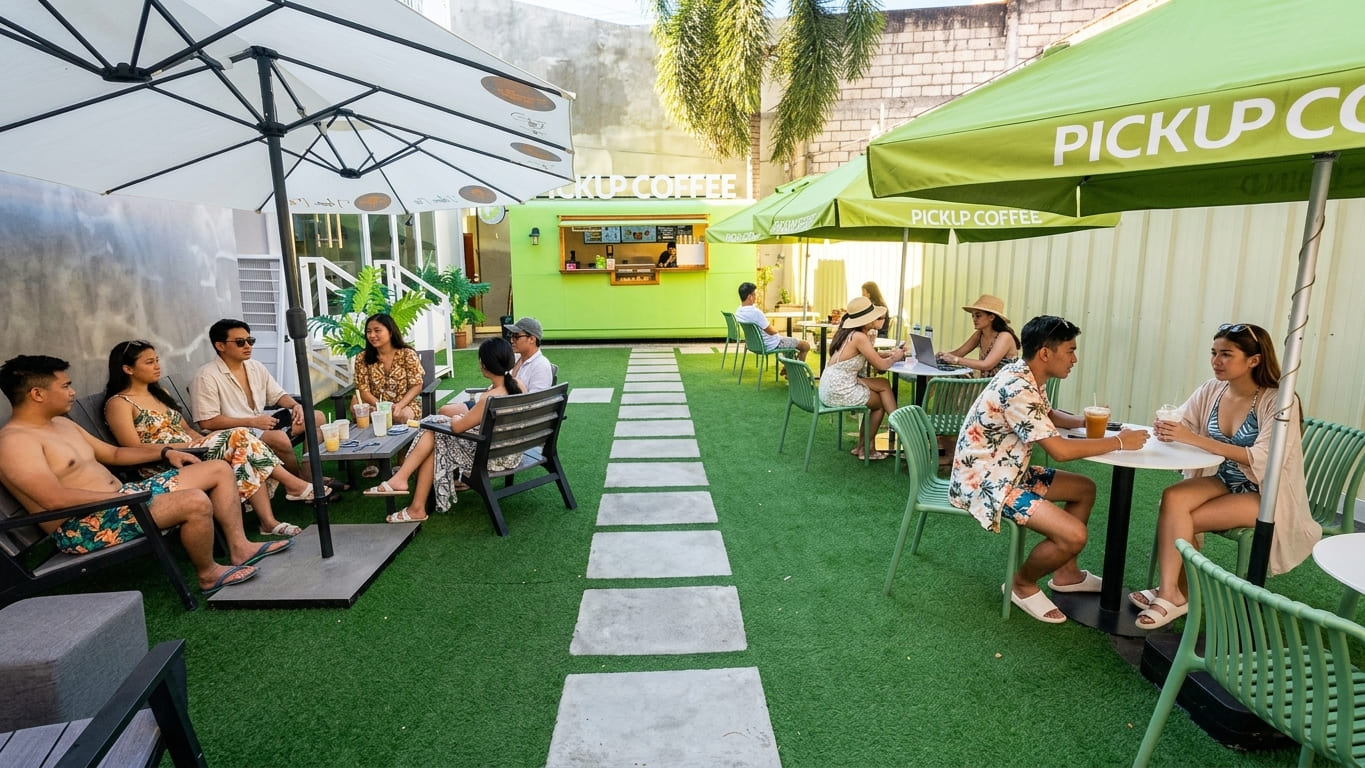
What caught my eye: the Manjuyod Sandbar
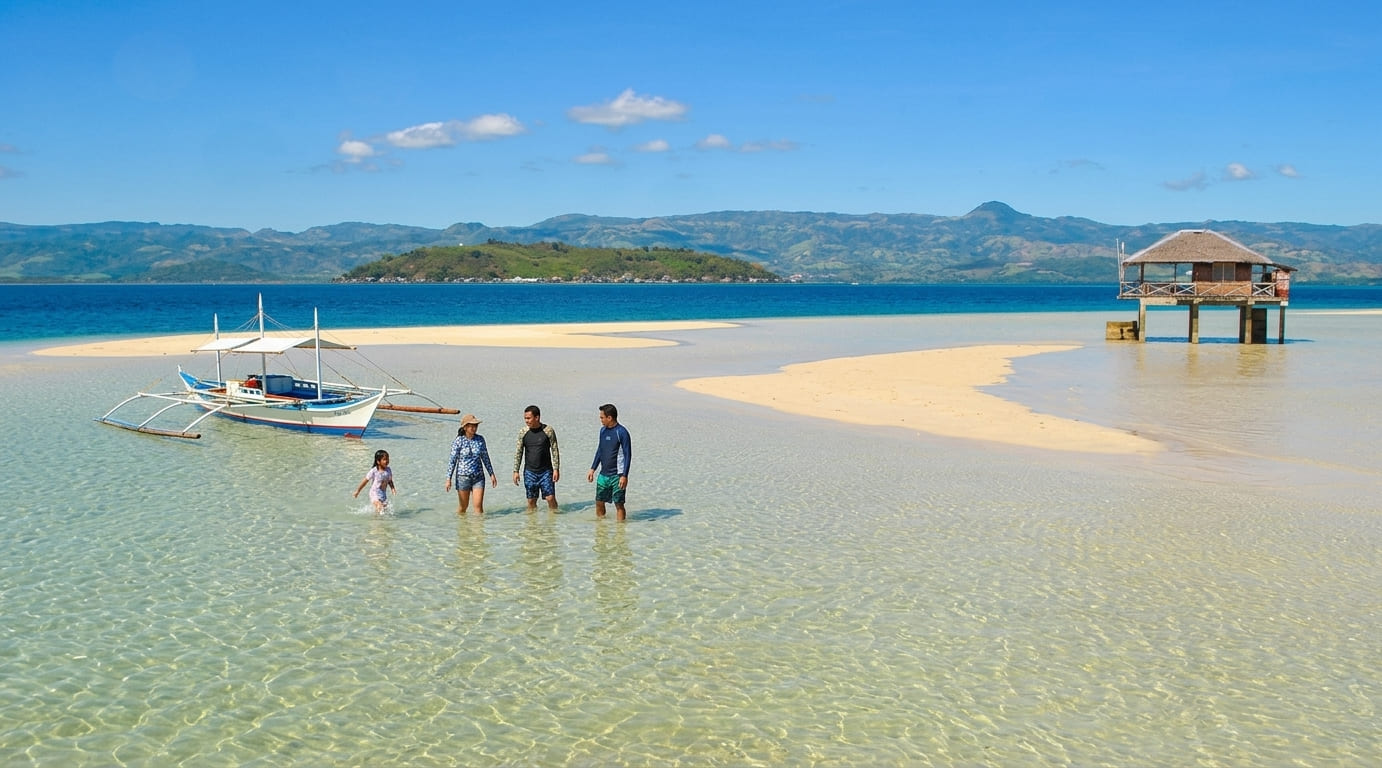
Exploring the Manjuyod Sandbar caught my eye. It is a long strip of white sand that shows at low tide, and it is a bigger outing than a walk from town. According to Suroy.ph, the trip from Dumaguete to Bais takes about 1.5 to 2 hours by bus or van, and boats leave from Capiñahan or Canibol wharf. A round-trip boat costs roughly ₱2,500 to ₱3,500 (about US$39 to US$55), plus a ₱30 entrance fee (about US$0.47). It is open daily from 6 a.m. to 6 p.m., and low tide is the time to go, so check the moon cycle first. The Smart Local adds that boat hire in 2021 started at ₱3,500 for five to seven people and that there are no restaurants on the sandbar, so bring food. Both guides date from 2021, and boat prices vary with the season, the day of the week, group size and how hard you bargain, so treat these as a rough range and confirm with a local operator. Dollar figures use ₱63.4 to US$1 (October 23, 2026).
Why visit Dumaguete, Philippines
Dumaguete is a small seaside university town on the island of Negros, in the Visayas. It is often called the City of Gentle People, a nickname Jonny Melon’s 2026 guide says it earned because its people are known for being gentle. It sits close to some of the best snorkeling in the region. Jonny Melon describes Silliman University, founded in 1901, as the first American university in the Philippines and in Asia. Solo Guides calls the city expat-friendly and very safe by Philippine standards, though it advises avoiding poorly lit areas late at night.
Getting to Dumaguete and getting around
- By air: Dumaguete Airport (DGT) is in the neighboring town of Sibulan, about 3.8 km from the city, and is served by Cebu Pacific, Cebgo and Philippine Airlines (Kupi). Jonny Melon lists flights from Manila at about 1.5 hours and roughly US$50 to US$150 one way, and from Cebu at about 50 minutes and roughly US$50 to US$100.
- By sea: Jonny Melon puts the ferry from Cebu City at about 5 hours. Solo Guides says ferries from Dumaguete Port also link to Siquijor and Bohol.
- Airport to town: a tricycle costs about ₱150 (about US$2.37) and takes about 15 minutes. Agree on the price first or use GrabTrike (Solo Guides).
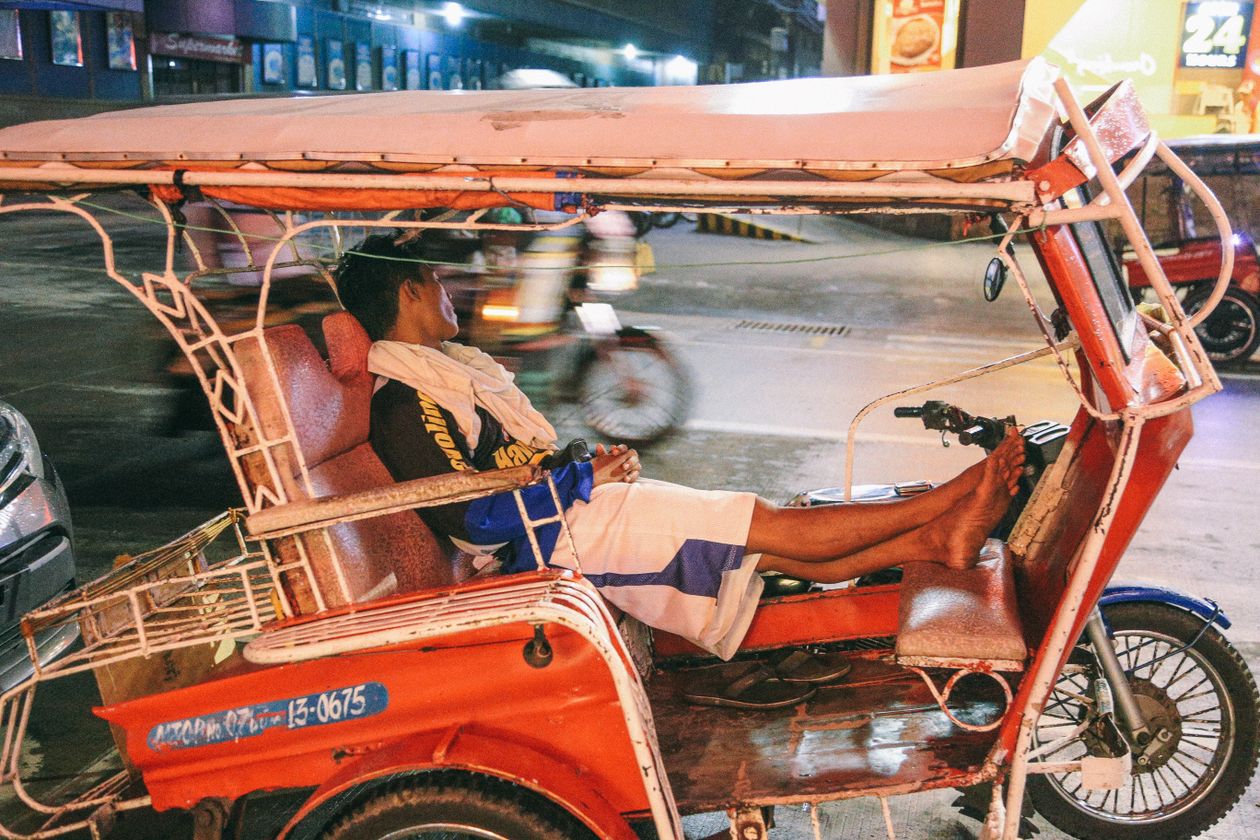
- Around town: tricycles are the main transport, about ₱15 to ₱25 a ride (about US$0.24 to US$0.39), and Solo Guides estimates ₱50 to ₱150 a day for local transport. Jonny Melon lists motorbike rental at ₱500 to ₱800 a day (about US$7.89 to US$12.62) and a car at ₱1,500 to ₱2,000 (about US$23.66 to US$31.55).
What a day can cost and where to stay
Solo Guides (updated June 2026) estimates a budget traveler’s day at ₱1,200 to ₱2,000 (about US$19 to US$32), not counting island day trips. That assumes a dorm bed at ₱500 to ₱900 (about US$8 to US$14), budget meals at ₱60 to ₱150 (about US$0.95 to US$2.37) and mid-range meals at ₱250 to ₱500 (about US$3.94 to US$7.89). A private room or resort will cost more. Jonny Melon names Claytown Pension House as a budget option, Sierra Hotel as mid-range and Atlantis Dive Resort in Dauin as luxury, without prices. Treat all of these as a rough range: they move with the season, the dates of your trip and the place you pick.
On a first visit, Solo Guides recommends staying in the city center, which is walkable and has food, bars and markets, and makes late returns easier. Dauin, which Jonny Melon places about 20 minutes south of the city, is a quieter beach area known for diving.
When to go
The guides do not agree exactly. Jonny Melon names February to June, Solo Guides names December to May, and Champion Traveler points to late February through March and early May to early June, with September to November the wettest stretch. Champion Traveler calls December the busiest month, and Solo Guides says the Buglasan festival in October and Sandurot in November fill rooms, so book ahead. Typhoon season can disrupt ferries and flights, so keep your plans flexible.
Meeting people in everyday places
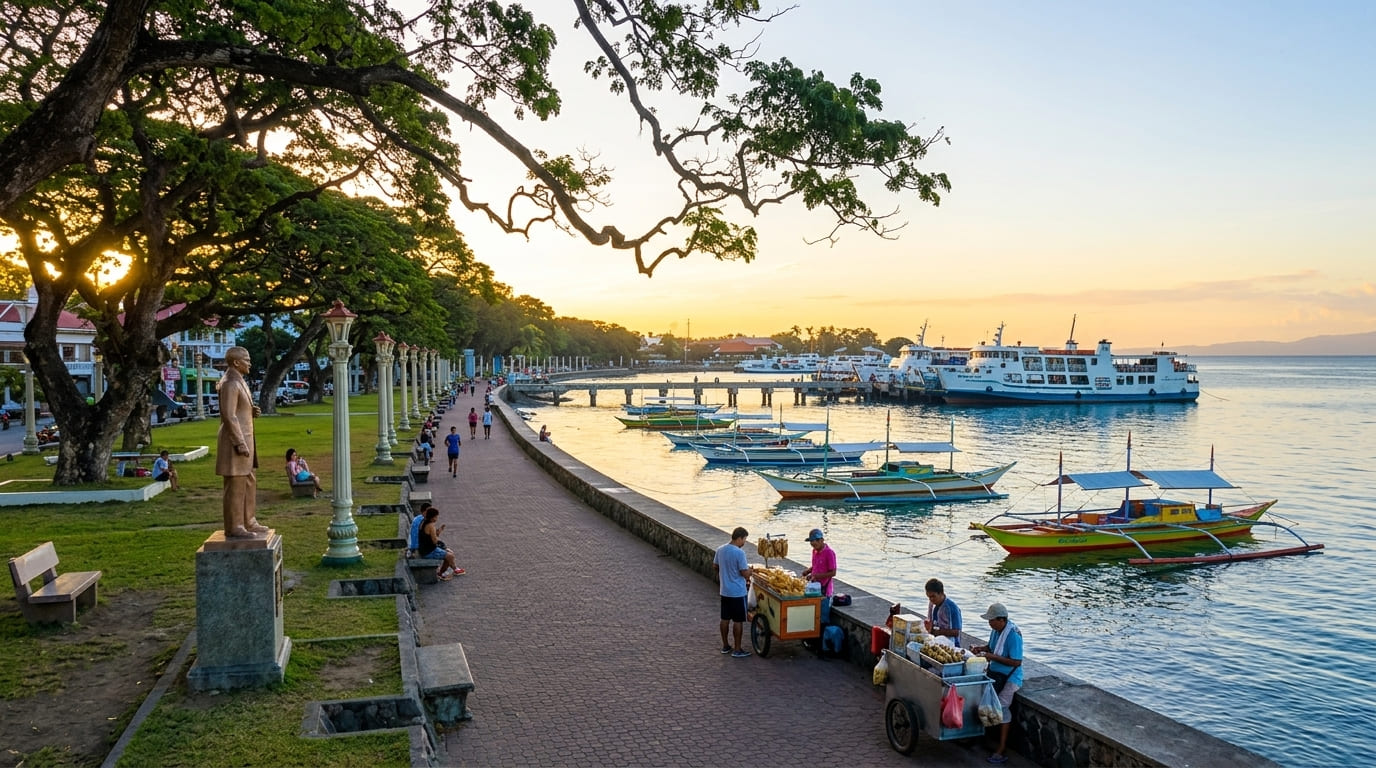
- Walk the Rizal Boulevard waterfront, a busy strip of restaurants, vendors and bars that hosts festivals with live music (Jonny Melon). It faces the Philippine Sea and is also a popular spot for sunrise.
- Spend time around Silliman University, founded in 1901. Its tree-lined approach and its Anthropology Museum, open Monday to Friday for a small fee, are a good reason to stroll the campus (Jonny Melon). Ask around the campus area for current cafes.
- Join a day trip to Apo Island, about 30 km off Dumaguete, to snorkel with sea turtles and reef fish. Jonny Melon’s budget route is a jeepney to Malatapay (₱20, about US$0.32), then a boat (₱3,500 round trip for up to three people, about US$55), plus ₱150 in marine park fees (about US$2.37) and ₱300 for gear and a guide (about US$4.73) per person. Resort packages cost more. Costs shift with the season (holidays and the dry months are busier), the size of your group and the operator, so plan for a range and confirm locally.
- Ask your hotel which local market is best for fruit and street food, and what days it runs.
- Make a day of the Manjuyod Sandbar: a bus or van to Bais, then a boat to the sandbar (details above).
- Join a group island tour. Solo Guides recommends organized tours as an easy way to meet people.
- Listen to live music. Solo Guides says Hayahay Treehouse has live music daily and calls Balay Ni Lola Bar a homey spot for chatting with locals and travelers. Venues change, so check first.
Evenings and nightlife
The video ends with a short tour of two of the city’s nightclubs, and it shows people simply enjoying the evening. Dumaguete is a university town, so there is music, food and company after dark as well as by day. Check recent reviews and ask your hotel or a local cafe which places are current, because venues and hours change.
The usual evening habits apply anywhere: watch your drink, keep your phone and wallet out of sight, take a registered tricycle or a ride-hailing car home, and tell someone where you are going. For a similar guide to evenings in another town, see our El Nido nightlife guide.
Say hello with a Kumusta card
The main local language is Bisaya (Cebuano), so the Bisaya side of the Kumusta card is a good fit. Fill in your name and Messenger name first, greet first, then offer the card.
Staying safe
Solo Guides rates Dumaguete very safe by Philippine standards. It still suggests avoiding poorly lit areas late at night and agreeing on a tricycle fare before you ride, because drivers sometimes quote tourist prices. Staying in the city center makes late returns easier. Keep your hotel details private, and meet people in public places. Read your government’s current advisory before you go, and see our safety guide.
Sources
- RayKayTV: Hmm.. Why do AMERICANS LOVE Dumaguete, Philippines (YouTube)
- Suroy.ph: Manjuyod Sandbar guide (published December 2021, updated August 2026)
- The Smart Local: Manjuyod Sandbar (published April 2021)
- Jonny Melon: Dumaguete tourist spots (published February 2026)
- Solo Guides: Dumaguete solo travel guide (published June 2025, updated June 2026)
- Champion Traveler: Best time to visit Dumaguete (undated)
- Kupi: Getting to Dumaguete (undated)
Guides
Moving to the Philippines With a Filipina Wife: What a U.S. Husband Needs to Know
Marrying a Filipina does not make you a resident. A plain-language guide to the 13(a) visa, staying while you wait, property, work and U.S. taxes.

General information, not legal advice. Researched October 24, 2026.
Marrying a Filipina does not make you a resident of the Philippines. That surprises a lot of men. Your wife can come home any time. You cannot just follow her and stay.
If you are moving to the Philippines with your Filipina wife, this post covers six things: your visa, how to stay while you wait for it, your wife’s status, property, work, and U.S. taxes. Rules change, so check each point with the Bureau of Immigration (BI) or a Philippine lawyer before you act.
Why I wrote this: many men decide that retiring to the Philippines is a cheaper alternative to staying in their home country. The phrase “live like a king” comes to mind. For many men, a lower cost of living in a tropical setting has mental and emotional benefits. Living on an island and building your own private oasis sounds relaxing, and you have 7,000 islands to choose from. Enjoy your journey.
1. Your visa: the 13(a) marriage visa
The visa for the foreign husband of a Filipino citizen is the 13(a) Non-Quota Immigrant Visa by Marriage. It leads to permanent residency, but not right away.
- Your wife is the petitioner. You file a joint letter to the BI Commissioner. You need your marriage certificate, her birth certificate showing she is a Filipino citizen, your apostilled birth certificate, and clearances. If you married outside the Philippines, you also need a Report of Marriage from a Philippine embassy or consulate.
- You both go to the interview. BI wants to see you and your wife in person.
- Where to apply. You can start at a Philippine consulate before you travel, or at BI after you arrive. One consulate warns that you must stay in the Philippines until BI finishes, which can take six months or more.
- It starts as a one-year probationary visa. After that you petition to convert to permanent status. One legal guide says to file at least 90 days before the probationary year ends. Do not let it lapse.
- Your country must give Filipinos similar rights. Check BI’s list for your passport.
- The visa depends on the marriage. If the marriage ends or is annulled, your status is at risk.
2. Staying while you wait
U.S. passport holders can enter visa-free for 30 days and extend at a BI office. Some sources say repeated extensions can run up to 36 months in some cases. Confirm the current rule with BI before you plan around it.
There is also the Balikbayan privilege, a one-year visa-free stay. It has conditions that are easy to miss:
- You must enter together with your wife.
- She must qualify as a balikbayan. By the official definition, that means a Filipino citizen who has been continuously out of the Philippines for at least one year.
- Showing a marriage certificate alone is not the test.
- Arriving on your own does not qualify.
3. Your wife’s status
Your wife is a Filipino citizen. She can return and live in the Philippines freely with her Philippine passport. Her citizenship is what your 13(a) is built on, so keep her PSA birth certificate in a safe place.
4. Property rules for foreigners in the Philippines
A foreigner cannot own land in the Philippines. Holding a 13(a) does not change that.
What the sources say you can do:
- Lease land. A standard lease for an individual foreigner is generally limited to 25 years. The new 99-year lease law (Republic Act 12252, signed in September 2025) is for qualified foreign investors with registered projects, not for every foreigner.
- Own a condominium unit. Foreigners can own units, but foreign ownership is capped at 40% of a project. Some buildings have already reached the cap. Get the current foreign-ownership figure in writing before you sign anything.
- Own the building, not the land. The Supreme Court has said the ban applies to land, not to the improvements built on it. A foreigner can own a house that sits on land titled to a Filipino spouse. More on this below.
- Land in your wife’s name. Land can be titled to a Filipino citizen. Legally, it is hers.
Our approach: In the Philippines, land is always titled to the Filipino citizen. It is the law, and that is fine with us. What is built on the land is a different matter, and it can be owned by either person. For Cirila and me, she is the one who needs the security of future land ownership. She is a little younger than me.
Take precautions and plan ahead. Always have a clear understanding of where you stand as a foreigner. In my experience, some relationships can and will go sideways. Be careful about buying on gut feeling alone, and think each purchase through first.
If you build on land titled to your wife
This is where couples get caught out. A few points that lawyers and court decisions keep coming back to:
- Put it in writing. The general rule is that the owner of the land owns what is built on it. If you want the house to be yours, lawyers say to document it: a written agreement or lease stating who owns the improvements, what happens to them if the arrangement ends, and your right to remove or be paid for them. One law firm also suggests the building permit and tax declaration name the person who owns the house.
- Money spent on the land itself may not come back. In Muller v. Muller (2006) and Beumer v. Amores (2012), the Supreme Court refused to let a foreign husband recover money he put into property titled to his Filipina wife. The court’s reasoning was that it would not let a foreigner get around the land ban. Do not assume you can get your money back if the relationship ends.
- A marriage settlement can help. A prenuptial or marriage settlement can spell out that your funds stay yours and who owns what. Land bought during a marriage is otherwise presumed to be hers.
- Some arrangements are risky. Lawyers warn that setups where a foreigner effectively controls land titled to a Filipino can run into the Anti-Dummy Law. Have a lawyer review any structure before you fund it.
- Inheritance. The law allows a foreigner to inherit land as a legal heir. Lawyers also mention a will with a lifetime right to use the property (a usufruct). Ask a lawyer how this would work for your family.
Before you pay a single peso, hire a Philippine real estate lawyer. Have the lawyer check the title, draw up the papers for the house, and explain what protection you do and do not have.
5. Working and doing business in the Philippines
The usual advice is that a foreigner needs an Alien Employment Permit (AEP) from the Department of Labor and Employment (DOLE). For a 13(a) holder, it is more nuanced:
- DOLE’s rules (Department Order 186, Series of 2017) list permanent residents and probationary or temporary resident visa holders under Section 13 as exempt from the AEP.
- Some lawyers still tell their clients to get a certificate of exemption. Ask DOLE or your lawyer which they want.
- Regulated professions (medicine, engineering, and others) need separate authorization from the Professional Regulation Commission, even with a 13(a).
- Some businesses are limited for foreigners. Ask a lawyer before you invest or register a company.
6. U.S. taxes follow you
The United States taxes its citizens on worldwide income, wherever they live. You still file a U.S. federal return every year. Two tools often come up: the Foreign Earned Income Exclusion and the Foreign Tax Credit. Whether either applies depends on your income. Foreign bank accounts can also trigger separate U.S. reporting. Use a U.S. tax preparer who works with expats, and ask before the first filing deadline, not after.
Before you go: a short checklist
- Marriage certificate (PSA copy, or a Report of Marriage if you married abroad)
- Your wife’s PSA birth certificate
- Your apostilled birth certificate and police clearances
- A plan for where you will live, and how you will hold it
- A U.S. expat tax preparer and a Philippine lawyer, lined up in advance
If you are 55 and thinking about this, pause long enough to put the plan on paper. Cover your bases first. Then go.
Still at the dating stage? Our guide to dating a younger Filipina covers money, family and gifts.
Sources
- Philippine Consulate (Hong Kong): 13(a) requirements, May 2025
- Philippine Embassy (Jakarta): 13(a) for spouses of Filipinos
- Respicio & Co.: Residence visa for a foreign spouse
- Respicio & Co.: Spousal visa requirements and costs
- Philippine Consulate (Toronto): Balikbayan privilege
- Philippine Embassy (New Zealand): Balikbayan FAQ
- Philippine Consulate (Frankfurt): visa-free stays and extensions
- DOLE AEP rules, D.O. 186-17 (summary)
- Respicio & Co.: Work permit options for foreign spouses
- Supreme Court e-Library: land ban applies to land, not to improvements
- Supreme Court e-Library: Muller v. Muller, G.R. 149615 (2006)
- Beumer v. Amores, G.R. 195670 (2012), case brief
- lawyer-philippines.com: house on a partner’s land
- lawyer-philippines.com: protecting a foreigner’s investment (prenup, usufruct)
- Philstar: foreigners can lease land up to 99 years (investors only; 25 years otherwise)
- Condominium Act, RA 4726, foreign ownership cap
Guides
El Nido Nightlife After Dark: A Solo Traveler’s Guide
What El Nido, Palawan is like after 9 PM: where the bars are, what a night out costs, when things close and how to get home safely.

El Nido is known for its lagoons and island hopping, but the town has a second life after dark. Streets of restaurants, bars and live music fill the town proper once the tours come back in. The video above is a night walk through El Nido Town Proper after 9 PM. This guide covers what you will find, what it costs, when things close and how to get home.
Video credit: the night walk above was filmed and published by PH Dot Net, a YouTube channel with walking tours and travel videos across the Philippines. If you enjoy it, please visit the channel and subscribe to support their work.
Researched guide: built from video tours and travel sources, linked at the end.
What the video shows
This walking tour gives you a wonderful overview of the nightlife and vendors in El Nido. The restaurants are well thought out for visitors. Entertainment is widely available, from live musicians to artists. It is an exceptional tour from a local point of view.
A note on sources: The details below come from the two written El Nido nightlife guides linked at the end, not from the video itself, and where they disagree, I say so. Prices and hours change, so confirm before you go. Prices are in Philippine pesos (₱) with US dollars alongside, at roughly ₱63 to US$1 (October 2026).
El Nido nightlife: where to go
- El Nido Town (Poblacion): the main hub, centered on Calle Hama (Hama Walking Street) and Rizal Street. Bars are within walking distance of each other. It is lively and social, and it can be crowded and noisy.
- Corong-Corong and Las Cabanas: a relaxed stretch with sunset bars, beach clubs and the occasional DJ, about 5 to 10 minutes from town by tricycle.
- Nacpan Beach: quiet after sunset, with a few beachfront bars and restaurants, about 45 minutes from town.
- Lio Beach: very quiet. One guide says restaurants and shops often close around 7 to 9 PM, so it suits a night walk more than a night out.
What kind of night to expect
Think relaxed rather than wild. One guide notes that dedicated nightclubs and all-night parties are rare. Most venues wind down around midnight, and a few party spots stay open until 3 or 4 AM on busy nights in peak season (November to April). DJ nights, fire shows and events are irregular, so ask your hotel what is on that night.
The venue types named in the guides include:
- Rooftop and sunset bars: Piece of Sky, Panorama Beach Club and Henri’s El Nido. Henri’s requires a reservation and a deposit, according to one guide.
- Beach bars with DJs or bands: Sandbreeze, SAVA and Hightides Bistro. The guide says Hightides’ live band is loud, so it is not the place for conversation.
- Sports and social bars: MABUHAY Sports Bar, with pool, sports screenings and karaoke rooms upstairs.
- Local and cocktail bars: The Pangolin, Amigos and Tribu Kuridas. Amigos is called the most budget-friendly, and Tribu Kuridas gets crowded late, so arrive early.
- Late-night food: Mazabor is listed as open 24 hours.
Opening hours in the guide vary by venue, for example The Pangolin from 6 PM to 3 AM and Hightides Bistro from 11 AM to 1 AM, but they can change with the season, so check before you head out.
What a night out costs
The two guides give different numbers, which is a reminder that prices vary by venue and season:
| Item | Guide 1 (Insights) | Guide 2 (Hotels Ranking) |
|---|---|---|
| San Miguel beer | ₱100 to 150 (about US$1.60 to US$2.40) | ₱70 to 120 (about US$1.10 to US$1.90) |
| Cocktail | ₱400 to 800 at most bars (about US$6 to US$13) | ₱150 to 380 (about US$2.40 to US$6) |
The second guide estimates a budget night at ₱400 to 600 (about US$6 to US$9.50) and a moderate night at ₱800 to 1,500 (about US$13 to US$24). Most bars are cash-only, and the ATMs in town can run out of cash on busy weekends, so bring enough pesos.
When things close
Most venues close between midnight and 2 AM, and one guide says the liquor licence caps service at 2 AM. Town-centre bars typically wind down around 12:30 AM on weeknights and 1:30 AM on weekends, and Corong-Corong bars close earlier. Happy hour runs from about 4 to 7 PM, and the sunset venues fill up around 4:30 PM. In heavy rain in September or October, the town may shut by 11 PM.
Timing matters for the season too. The video was posted in June 2026, and the busiest nightlife months are November to April. See our month-by-month guide before you book.
Getting home safely
- Tricycles don’t use meters. Agree on the fare before you get in. One guide lists town hops at ₱50 to 100 (about US$0.80 to US$1.60), Corong-Corong at about ₱150 (about US$2.40), Las Cabanas at ₱150 to 200 (about US$2.40 to US$3.20), and Lio Beach or the airport at about ₱300 (about US$4.80).
- They get scarce late. The other guide says tricycles stop running around midnight. Stay within walking distance of your hotel or arrange your ride home in advance, especially for secluded beach bars.
- Nacpan is a bigger trip. Roughly ₱1,000 (about US$16) one way by private tricycle, or about ₱400 (about US$6.30) one way by shared van, according to one guide. A return trip with a wait costs more.
Safety tips for a solo traveler
Both guides call El Nido generally safe at night, with welcoming locals, and both add the usual cautions. I would follow them:
- Watch your belongings, and never leave a drink unattended.
- Avoid walking alone on unlit side streets or remote beaches late at night.
- Drink responsibly. One guide warns against unregulated homemade lambanog, which has been linked to methanol poisoning.
- Tell someone where you are going, and keep your hotel’s address on your phone.
For the bigger picture, read Is the Philippines Safe for Solo Travelers? and how much a solo trip costs. If El Nido is on your list, our beach guide covers Nacpan by day.
FAQ
Is El Nido nightlife good for a solo traveler?
It can be. Bars are close together in town, the guides call it generally safe, and the pace is relaxed. Plan your ride home before you go out.
What time do the bars close in El Nido?
Most close between midnight and 2 AM. A few stay open until 3 or 4 AM in peak season, and the town can shut earlier in heavy rain.
How much does a night out in El Nido cost?
One guide estimates ₱400 to 600 (about US$6 to US$9.50) for a budget night and ₱800 to 1,500 (about US$13 to US$24) for a moderate one. Bring cash.
Is there a night market in El Nido?
One guide says the carnival-style night market has not returned since it relocated in 2026, though street vendors and food carts still operate around town. Check locally for updates.
Sources
Checked October 21, 2026. Video: El Nido, Palawan Nightlife After 9 PM, by PH Dot Net on YouTube.
- El Nido Insights: El Nido Nightlife 2026
- El Nido Hotels Ranking: El Nido Nightlife 2026
- PH Dot Net: El Nido, Palawan Nightlife After 9 PM (YouTube)

Life Is Your Decision, Make It Count.
Steve and Cirila
SoloPhilippines.com
Questions or just want to say hello? Send us a note.
Guides
Best Beaches in the Philippines for Solo Travelers
Six Philippine beaches compared for solo travelers: how to get there, when to go, what it costs, and what to know about swimming and safety.
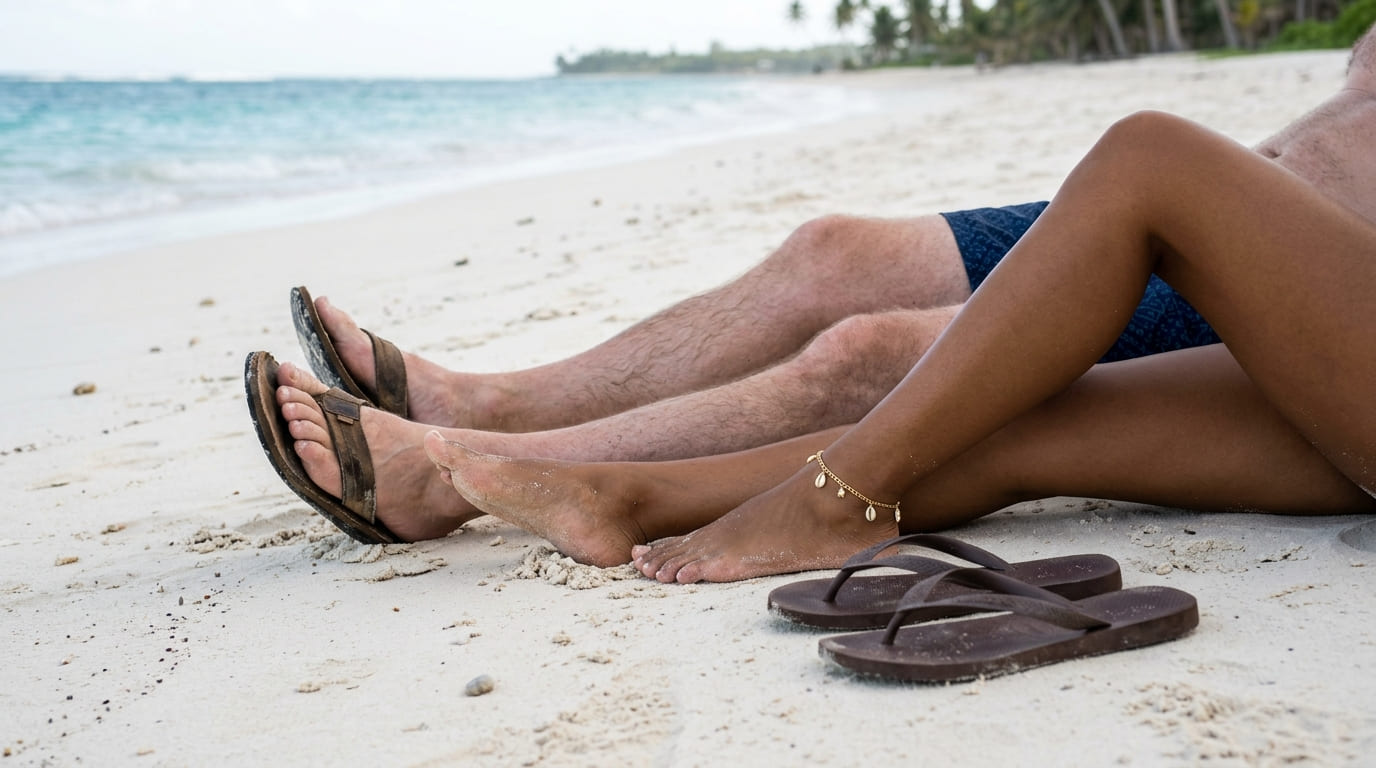
The Philippines has more than 7,000 islands, so the right beach depends on the kind of trip you want. This guide compares six well-known beaches for a man traveling alone: how to get there, when the water is calmest, what the extras cost, and what to watch for.
A note on sources: we have not been to every beach on this list. The details below come from the travel guides linked at the end, and where a price or schedule comes from a specific guide, we say so. Fares and ferry times change, so confirm them before you book. Prices are in Philippine pesos (₱) with US dollars alongside, at roughly ₱63 to US$1 (October 2026).
Video credit: the video above was filmed and published by The Wanderlovers, a YouTube channel with travel guides and videos from the Philippines. If you enjoy it, please visit the channel and subscribe to support their work.
Quick picks
| Beach | Best for | Season note |
|---|---|---|
| White Beach, Boracay | Famous sand, plenty of choice | Calm Nov–Apr; swimming often unsafe Jun–Oct |
| Nacpan Beach, El Nido | A long, open beach and a day out | Can turn rough without warning |
| Alona Beach, Panglao | Easy access, calm shallows | Dry Dec–May; calmest Mar–Apr |
| Cloud 9 area, Siargao | Surf culture and island day trips | Surf Jul–Nov; beach days Mar–Sep |
| Santa Fe, Bantayan Island | Lower costs, road-and-ferry access | Best Jan–Jun; rougher Oct–Dec |
| Paliton Beach, Siquijor | Sunsets and snorkeling | Go early; busy by noon |
White Beach, Boracay
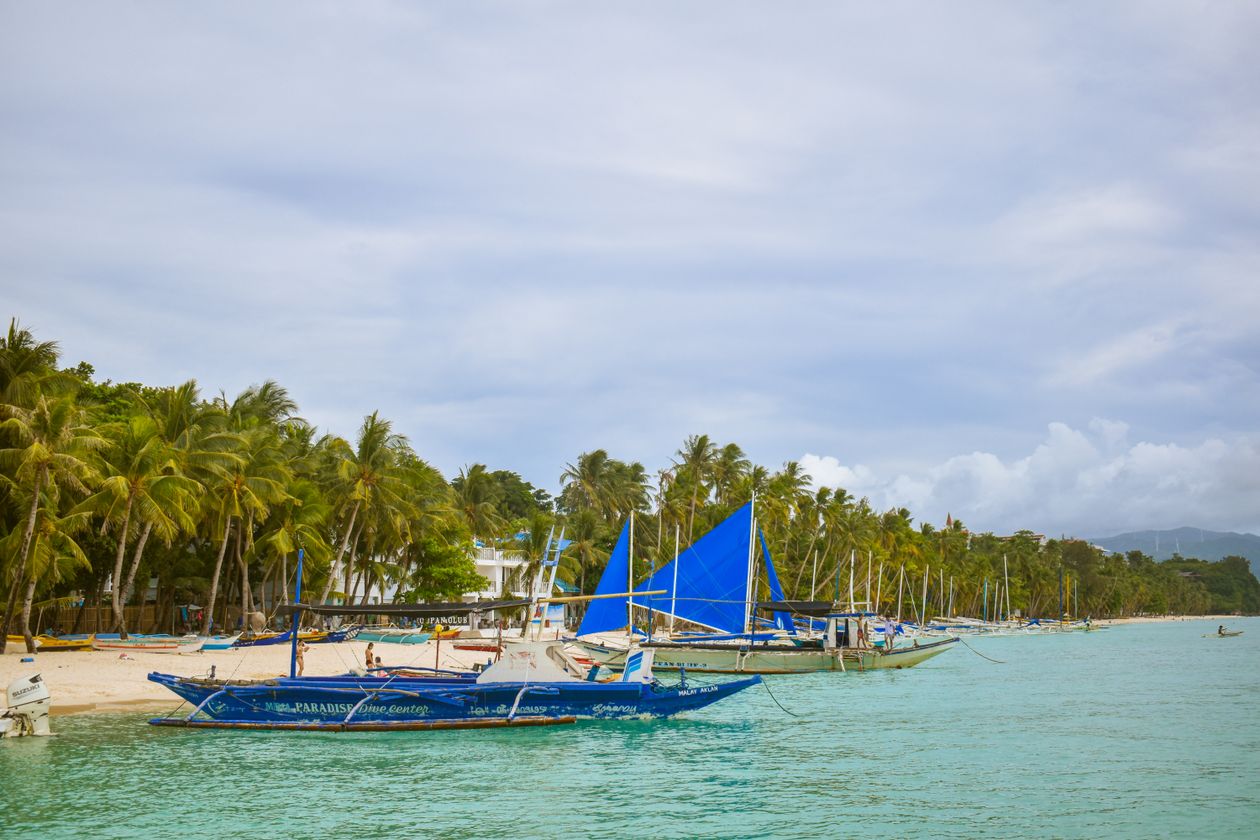
White Beach runs about 4 km from Station 1 in the north to Station 3 in the south, and the whole length is open to the public whichever hotel you choose (Wikivoyage). The three stations feel very different:
- Station 1: the widest beach, with upscale resorts and a generally peaceful feel.
- Station 2: the commercial hub, and the busiest and noisiest part.
- Station 3: quieter, less developed and the cheapest.
Motorized vehicles are not allowed on the beach, and lifeguards patrol each station. The calm season is November to April. From June to October, strong winds and waves often make White Beach unsafe for swimming, and there is a typhoon risk.
Getting there: fly into Caticlan, then take a tricycle (₱40, about US$0.65) or walk about 10 minutes to the jetty. The boat to Boracay costs ₱25 (about US$0.40), plus a ₱100 terminal fee (about US$1.60) and a ₱75 environmental fee (about US$1.20). Kalibo airport is about 90 minutes away by road; vans that include the ferry run about ₱200 (about US$3.20). ATMs on the island are scarce and sometimes run out, so bring cash.
Our take: in the dry season, Station 1 or Station 3 gives you the famous sand without the Station 2 noise.
Nacpan Beach, El Nido
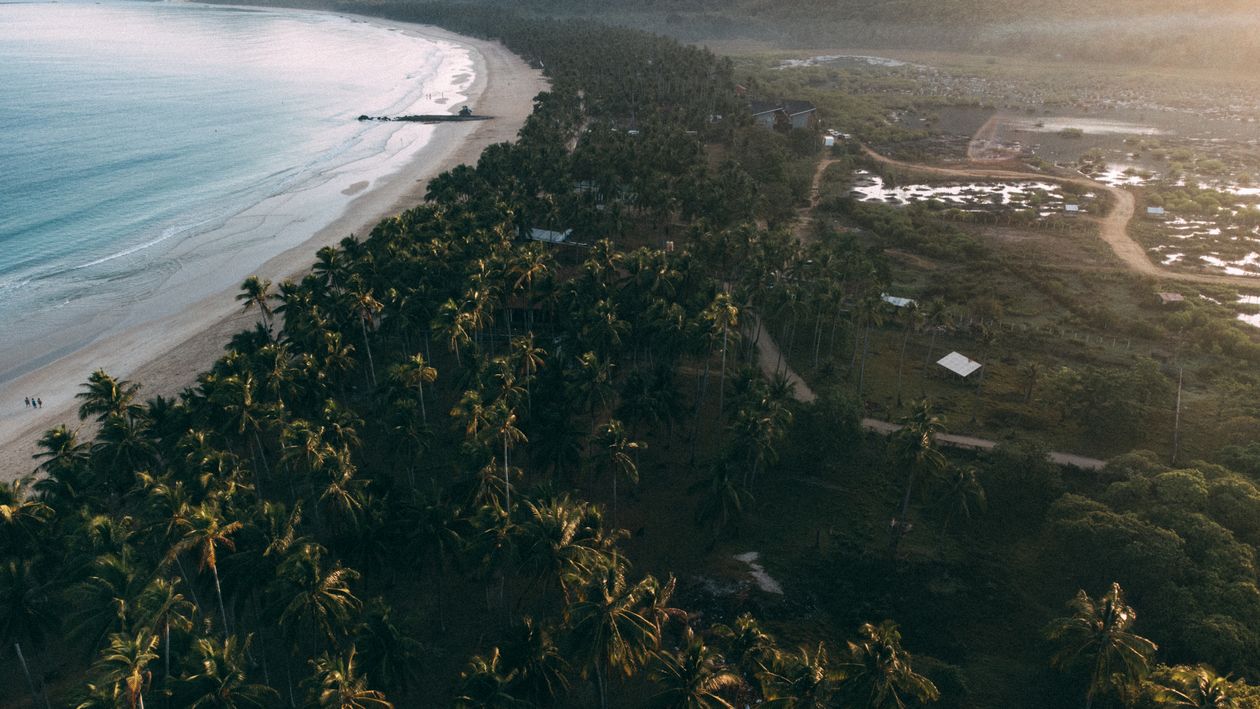
Nacpan is a 4-km strip of sand north of El Nido town. According to a philippinebeaches.org guide (first published in 2014, last updated in 2021, so prices may have changed), a tricycle from town for up to four people costs ₱1,500 (about US$24) and a van for up to 12 costs ₱3,000 (about US$48). Many resorts and tour operators also sell day tours.
The same guide warns that the cape can get rough without warning. Treat that seriously: check conditions with locals before you swim, and avoid going in alone when the surf is up. Facilities are limited. The guide mentions one paluto-style restaurant a few yards from the shore and suggests ordering ahead, so bring water, sun protection and cash.
Our take: a good day trip rather than a base, especially if you want space and a long walk on the sand.
Alona Beach, Panglao (Bohol)
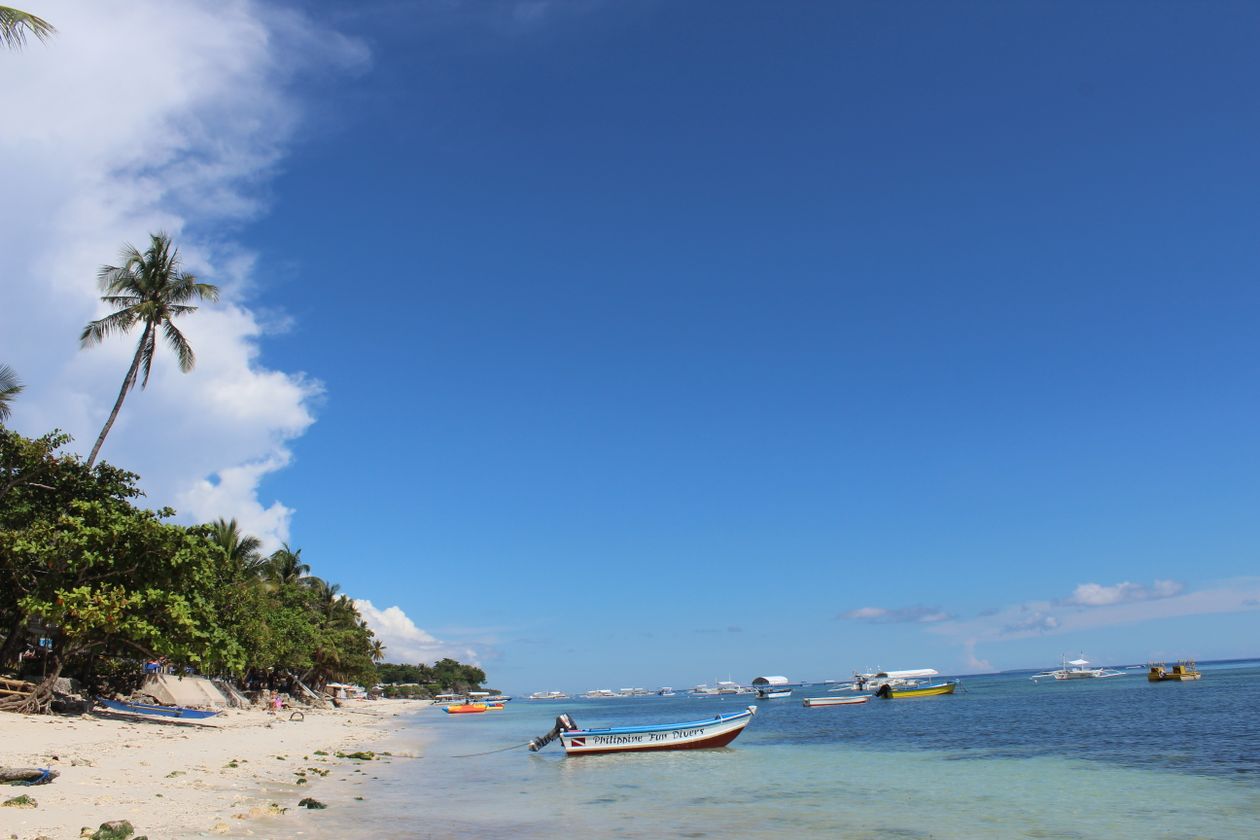
Alona is about 1.5 km of white sand on the southwest coast of Panglao Island. A Bohol travel guide describes shallow, calm water near shore, with shallows extending 20 to 30 meters out. December to May is the dry season, with the calmest seas in March and April.
Getting there: from Bohol-Panglao International Airport, a taxi costs ₱300–500 (about US$5–8) and a tricycle ₱150–200 (about US$2.40–3.20). From Tagbilaran, a direct tricycle takes about 45 minutes and costs ₱300–400 (about US$4.80–6.30).
What to know: the guide warns of strong currents on incoming tides near boat launch areas, and of sea urchins and sharp coral near rocky spots, so reef shoes help. Jellyfish are occasional. It also recommends reef-safe sunscreen. Nightlife is lively but mellow, calmer than Boracay or Siargao. There are restaurants, pharmacies and clinics, but the nearest hospital is in Tagbilaran, about 45 minutes away. ATMs can run out in peak season.
Our take: the easiest of the six for a first beach stay, because of the short transfer, calm shallows and the services nearby.
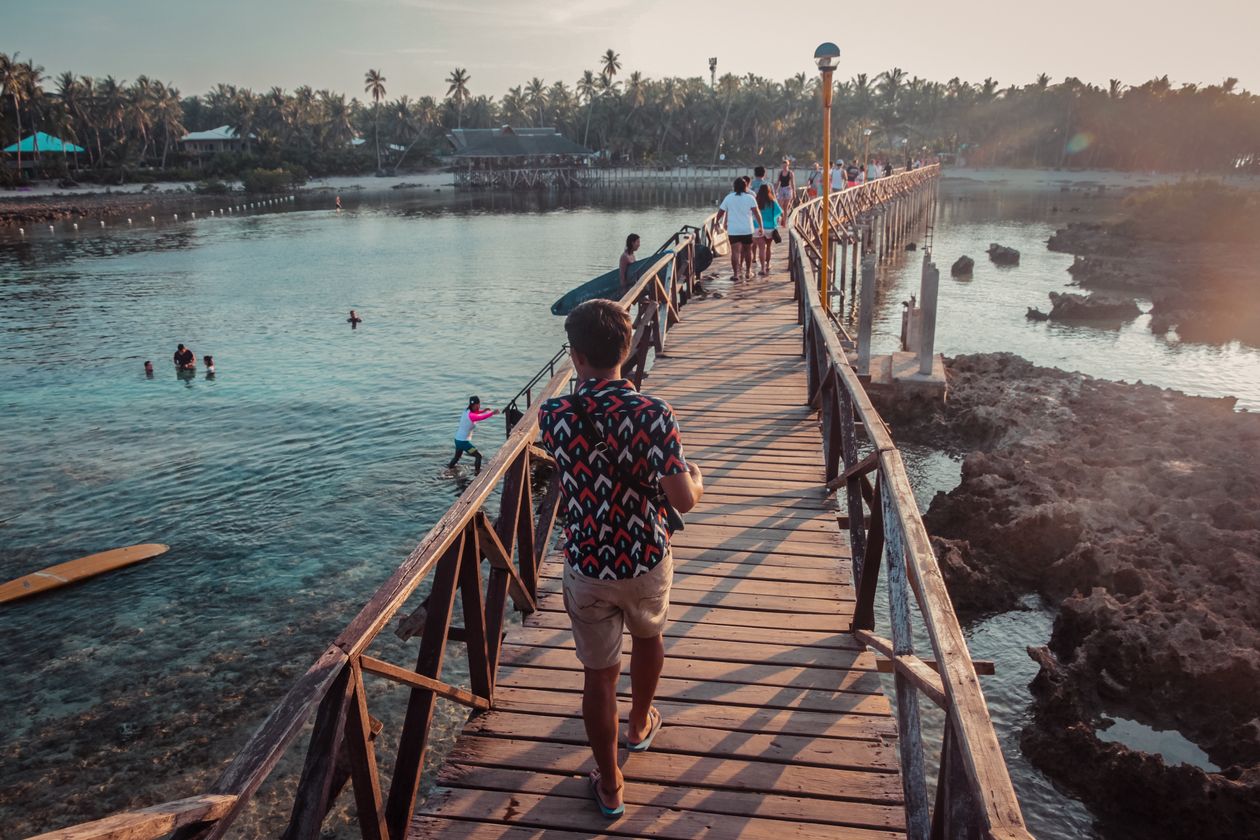
Cloud 9 and beyond, Siargao
Siargao is best known for the Cloud 9 surf break in General Luna, which is also the island’s nightlife hub. Tourism Philippines gives July to November as the best surf season, with the Siargao International Surfing Cup each September, and March to September as the drier months for swimming and island hopping. Its list of other stops includes Sugba Lagoon, the Magpupungko tidal rock pools, Guyam Island and the Naked Island sandbank. The source gives no difficulty rating for Cloud 9, so ask a local operator before surfing or exploring the rock pools.
Getting there: the island’s airport is Sayak (IAO). Suroy.ph says there is no longer a direct Manila flight, because flights moved to Clark in 2025 and Philippine Airlines ended its Clark route on May 4, 2026. Indicative one-way fares it checked in August 2026:
- From Clark: about 2h20–2h30, ₱1,900–3,600 (about US$30–57).
- From Cebu: about 1 hour, ₱2,500–5,000 (about US$40–79).
- From Davao: about 1h10, ₱1,900–2,500 (about US$30–40).
You can also take a ferry from Surigao City to Dapa: about 1.5 hours by fastcraft or 3.5 to 4 hours by RORO. From Sayak to General Luna is 45 to 60 minutes by road; a shared van costs ₱300–400 (about US$5–6). Fares are moving because of fuel costs, so check before you book.
Santa Fe, Bantayan Island
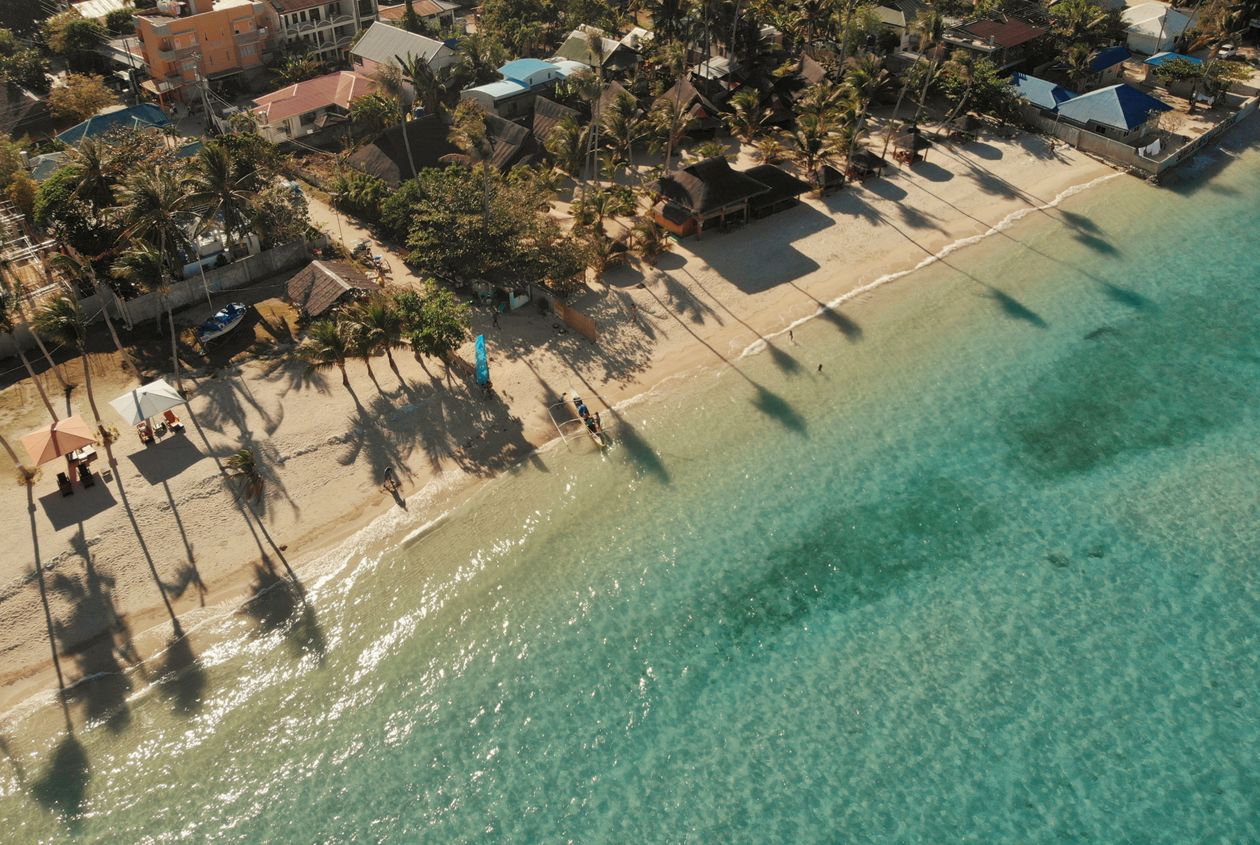
Bantayan sits off northern Cebu, and most visitors stay in Santa Fe. A Lakwatsero travel guide lists beaches there including Alice Beach, Kota Beach (Camp Sawi), Maricaban Beach and Paradise Beach, and says January to June is the best time. October to December can bring heavier rain and rougher sea crossings.
Getting there (June 2026 rates from the guide): a bus from Cebu North Terminal to Hagnaya Port takes about 3 hours and costs about ₱290 (about US$4.60). The ferry from Hagnaya to Santa Fe takes about an hour and costs about ₱370 (about US$5.90). The guide says no airline currently flies to the island.
Costs: budget rooms start around ₱600–700 a night (about US$9.50–11), and resorts from about ₱1,700–2,000 (about US$27–32). Tricycles and motorbikes are the main transport; a motorbike rents for about ₱350 a day (about US$5.60). Cards are accepted only at some places, and ATMs and banks are in Bantayan town.
Paliton Beach, Siquijor
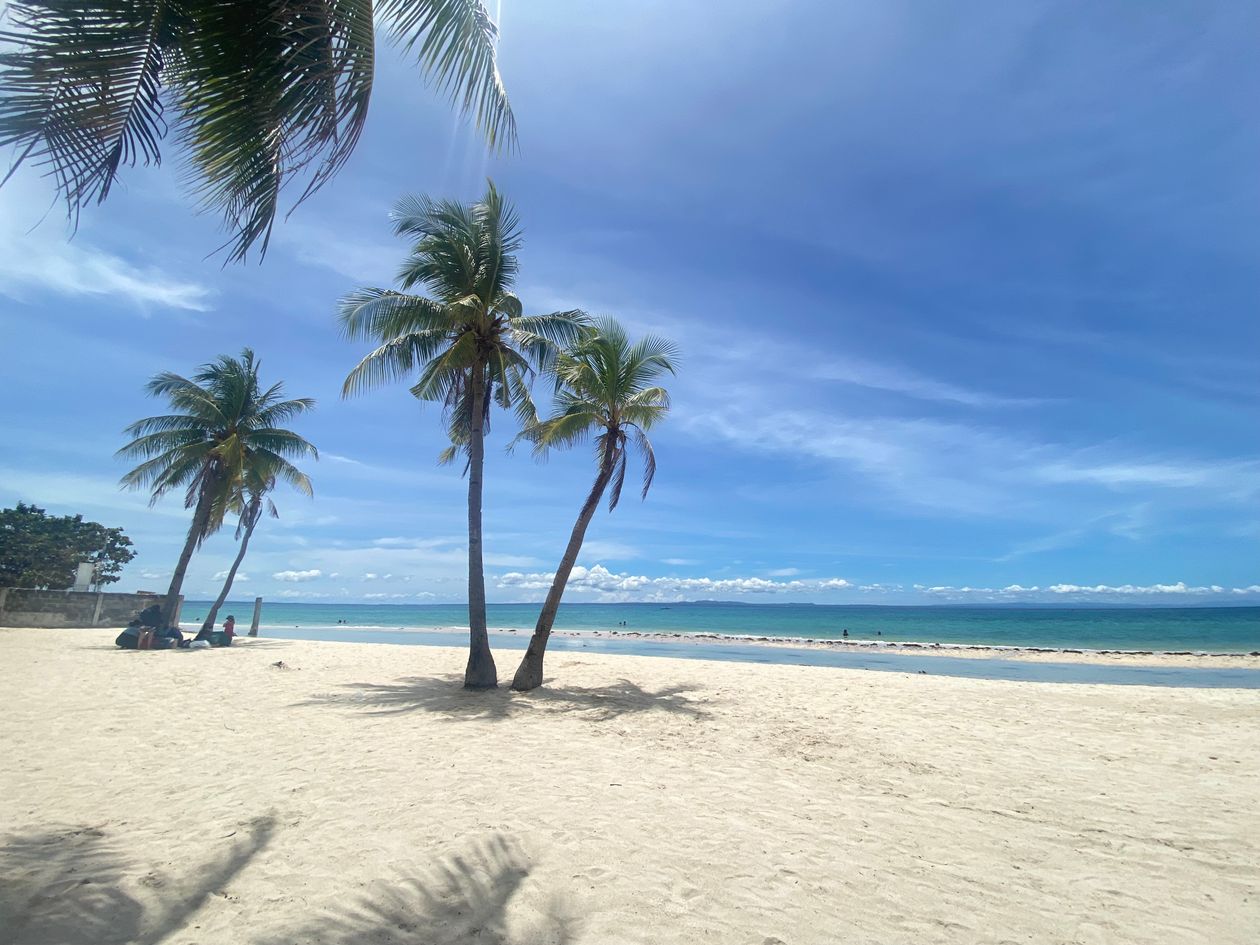
Paliton is in San Juan, on Siquijor, and philippinebeaches.org describes fine, bone-white sand and turquoise water. Entry is free, and it is one of the best sunset spots on the island. The guide advises going early, because the beach can get very crowded at noon. The area is a marine sanctuary, and snorkeling is possible if you bring your own gear.
Getting there: a tricycle from Siquijor port to San Juan town costs about ₱250–300 each way (about US$4–4.80). Facilities are not listed, so bring snacks, drinks, a power bank and enough cash. If you want to rest under the trees, ask permission first.
Beach tips for a solo traveler
- Ask about the water. Check with lifeguards or locals before swimming, and skip the water on your own when it is rough. Several of the guides above warn about sudden waves or tide-driven currents.
- Match the season. The same beach can be calm in March and unsafe in July. See our month-by-month guide.
- Protect your feet and skin. Reef shoes help around rocks and coral, and the Alona guide recommends reef-safe sunscreen.
- Carry cash. ATMs are scarce or can run out on Boracay, Alona and Bantayan.
- Plan the basics. Our guides on safety, trip costs and a two-week itinerary cover the rest, and the first-timer’s guide is a good place to start.
FAQ
Which beach is best for a first-timer?
In our view, Alona Beach on Panglao, because the airport transfer is short, the nearshore water is shallow and calm, and restaurants, pharmacies and clinics are close. Boracay’s Station 1 or 3 in the dry season is the other easy choice.
When is the best time for the beach?
It depends on the island. The sources above point to roughly November to April for Boracay, December to May for Panglao, January to June for Bantayan and March to September for Siargao’s swimming and island days. Our month-by-month guide goes into more detail.
Is it safe to swim at these beaches?
Conditions change with the season and tide. Boracay has lifeguards at each station, but the guides warn about unsafe swimming from June to October, sudden rough water at Nacpan and incoming-tide currents at Alona. Ask locally and do not swim alone in rough water.
How much does it cost to reach these beaches?
Local transfers are cheap: roughly ₱40–500 (about US$0.65–8) for the short legs on Boracay and Panglao, and about ₱250–300 each way to reach Paliton. Flights and ferries to Siargao and Bantayan are the larger costs. All figures are from the sources below and can change.
Sources
Checked October 19, 2026. Prices and schedules are as stated by each source.
- Wikivoyage: Boracay
- philippinebeaches.org: Nacpan Beach quick guide
- Bohol-Philippines.com: Alona Beach guide
- Suroy.ph: How to get to Siargao
- Tourism Philippines: Siargao
- Lakwatsero: Bantayan Island travel guide
- philippinebeaches.org: Paliton Beach tips
- The Wanderlovers: Our Guide to the Best Beaches in the Philippines (YouTube)
Life Is Your Decision, Make It Count.
Steve and Cirila
SoloPhilippines.com
Questions or just want to say hello? Send us a note.


Dumaguete Video Tour: Manjuyod Sandbar, Apo Island and Evenings

Moving to the Philippines With a Filipina Wife: What a U.S. Husband Needs to Know

Hilot Massage: Traditional Filipino Healing Massage



-

 Retirement2 years ago
Life in the Philippines Has Its Advantages: My Story
-

 Guides5 days ago
Best Beaches in the Philippines for Solo Travelers
-

 Lifestyle2 years ago
Top Delicacies: Best Foods to Try in The Philippines
-

 Guides3 days ago
El Nido Nightlife After Dark: A Solo Traveler’s Guide
-

 Romance4 days ago
Dating a Younger Filipina: Pay Attention!
-
 Therapy3 days ago
Hilot Massage: Traditional Filipino Healing Massage
-

 Guides6 days ago
A 2-Week Solo Itinerary for the Philippines
-

 Therapy3 days ago
Health and Wellness in the Philippines: A Practical Guide
You must be logged in to post a comment Login